Privacy Policy
RETURN & REPLACEMENT POLICY
allindiareportershop.com
Effective Date: 1st Jan 2026
At All India Reporter Shop (www.allindiareportershop.com), we are committed to delivering quality legal publications and books to our customers. Please read our Return and Replacement Policy carefully before placing an order on allindiareportershop.com.
1. NO REFUND POLICY
All India Reporter Shop does not offer monetary refunds under any circumstances. All sales made on allindiareportershop.com are final. We offer replacements only, subject to the conditions outlined below.
2. REPLACEMENT ELIGIBILITY
A replacement request on allindiareportershop.com will be considered solely in the following cases:
- Wrong Item Dispatched – You received a book/publication different from what was ordered on allindiareportershop.com.
- Damaged Item Received – The book/publication arrived in a physically damaged condition (torn pages, broken spine, water damage, etc.)
- Defective Item – The book/publication has a manufacturing or printing defect rendering it unusable.
3. CONDITIONS FOR REPLACEMENT
To be eligible for a replacement, the following conditions must be met:
• The replacement request must be raised within 7 days of delivery.
• The item must be unused, unread, and in its original packaging.
• Proof of purchase from allindiareportershop.com (order number/invoice) must be provided.
• Clear photographs of the wrong/damaged item must be submitted at the time of the request.
4. HOW TO RAISE A REPLACEMENT REQUEST
To initiate a replacement, please contact us at:
🌐 www.allindiareportershop.com
📧 support@airwebworld.com
📞 +91-8380-005-660
Provide your Order ID, photographs of the item, and a brief description of the issue.
5. REPLACEMENT PROCESS
Once your request is verified and approved by allindiareportershop.com, a replacement of the same title/item will be dispatched within 15 working days. Replacement is subject to stock availability. In the event the same item is unavailable, we will notify you and offer an equivalent title or store credit.
6. NON-ELIGIBLE CASES
Replacements will NOT be provided in the following situations:
• Change of mind or incorrect order placed by the customer.
• Items returned without prior intimation or approval from allindiareportershop.com.
• Damage caused after delivery due to mishandling by the customer.
• Requests raised after 7 days of delivery.
• Orders not placed directly through allindiareportershop.com.
7. RETURN SHIPPING
In cases where the item needs to be returned before dispatch of the replacement, return shipping instructions will be provided by allindiareportershop.com. Return shipping costs, if any, will be borne by All India Reporter Shop only in cases of wrong dispatch or damaged goods confirmed by us.
8. GOVERNING TERMS
This policy applies exclusively to purchases made on allindiareportershop.com. All India Reporter Shop reserves the right to amend this policy at any time without prior notice. The updated policy will be published on allindiareportershop.com and shall be effective immediately upon posting.
For any queries regarding this policy, please write to us at support@airwebworld.com or visit www.allindiareportershop.com.



Principal, DR. MAHENDRA SUBHASH KHAIRNAR –
This book offers a significant opportunity to revisit the Emergency through the prism of constitutionalism, democracy and the rule of law. The title itself is evocative. The expression “Constitution Eclipsed” conveys the idea that although the Constitution continued to exist formally, its democratic spirit and guarantees of liberty were substantially overshadowed during the Emergency. One of the principal strengths of Constitution Eclipsed is its focus on the relationship between the Emergency and the constitutional structure. The book can be read as an examination of the circumstances in which constitutional safeguards become vulnerable when political authority is concentrated.
The greatest value of Constitution Eclipsed lies in its ability to stimulate constitutional reflection. For an academic reader, the book is best approached not simply as a political account of the Emergency but as a starting point for a broader study involving constitutional provisions, parliamentary debates, judicial decisions, political developments and subsequent constitutional amendments. For students of law and constitutional studies, the history of the Emergency is therefore not simply a lesson in what happened in 1975.
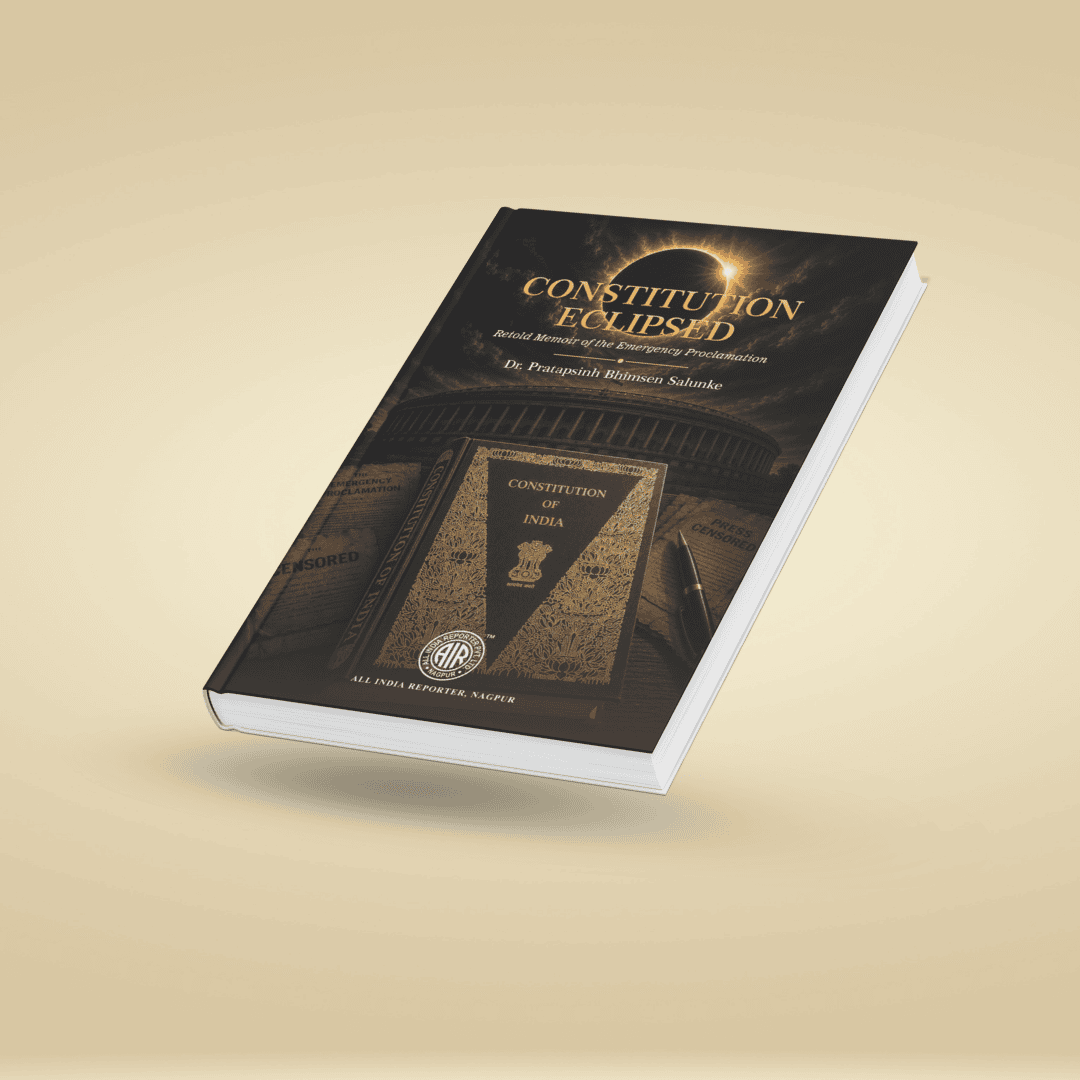
Dr. Pratapsinh Bhimsen Salunke’s Constitution Eclipsed – Retold Memoir of the Emergency Proclamation provides an opportunity to revisit one of the most important and difficult chapters of India’s constitutional journey.
Asst. Prof. Shyam Gulve –
This book, Constitution Eclipsed – Retold Memoir of the Emergency Proclamation, authored by Dr. Pratapsinh Bhimsen Salunke, is a compelling account of one of the most critical episodes in India’s democratic history—the Emergency of 1975. The book goes beyond a conventional historical account. It examines power, liberty, executive discretion, judicial authority, and democratic institutions. Its strength lies in bringing together constitutional jurisprudence, political thought, judicial reasoning, comparative perspectives, and literature. The chapters on administrative discretion, Fundamental Rights, the 44th Amendment, Article 352, the Emergency, habeas corpus, the judiciary, and the executive are not written like ordinary constitutional commentary. They invite the reader to think and rethink. The author also brings a literary sensibility to jurisprudence. Language, metaphor, imagination, and human experience become part of the constitutional discussion. The quotations at the beginning of each chapter add another layer of reflection. They make the reader pause before entering the discussion. The quotation attributed to Pablo Picasso in the tenth chapter—“The artist must discover a way to convince the general public the truth of his lies”—is particularly striking. Such quotations challenge the reader’s assumptions and open new ways of looking at truth, power, and political reality.
Perhaps the most appreciable aspect of the book is the depth and breadth of research that has gone into its making. The extensive references used throughout the book reveal the author’s painstaking engagement with a vast body of material. Scholarly works, judicial decisions, constitutional debates, historical accounts, writings of Indian and foreign scholars, and experiences from different countries are carefully brought together to support and explain the arguments. The book therefore feels deeply researched rather than merely narrated. The author’s detailed reading of Supreme Court judgments and constitutional cases is especially noteworthy. His discussion of habeas corpus, Fundamental Rights, executive power, and judicial authority goes beyond simply explaining the judgments. He examines their reasoning, context, contradictions, and consequences. This takes the reader deeper into the constitutional questions raised by the Emergency. The Emergency thus appears not merely as a chapter of the past. It becomes a continuing reminder of the fragility of liberty and democracy. What makes the book special is its ability to turn constitutional reading into an intellectual experience. It encourages the reader to read slowly, question deeply, and rethink established ideas. Ultimately, ‘Constitution Eclipsed’ is more than a memoir of the Emergency. It is a thoughtful journey through law, history, jurisprudence, political thought, and literature. It is a work shaped by extensive research and sustained intellectual engagement. It reminds us that democracy depends not only on constitutional text, but also on institutional courage, judicial independence, political restraint, and a constant commitment to liberty.
Asst. Prof. Shyam Gulve –
‘Constitution Eclipsed – Retold Memoir of the Emergency Proclamation’, authored by Dr. Pratapsinh Salunke, is a compelling account of one of the most critical episodes in India’s democratic history—the Emergency of 1975. The book goes beyond a conventional historical account. It examines power, liberty, executive discretion, judicial authority, and democratic institutions. Its strength lies in bringing together constitutional jurisprudence, political thought, judicial reasoning, comparative perspectives, and literature. The chapters on administrative discretion, Fundamental Rights, the 44th Amendment, Article 352, the Emergency, habeas corpus, the judiciary, and the executive are not written like ordinary constitutional commentary. They invite the reader to think and rethink. The author also brings a literary sensibility to jurisprudence. Language, metaphor, imagination, and human experience become part of the constitutional discussion. The quotations at the beginning of each chapter add another layer of reflection. They make the reader pause before entering the discussion. The quotation attributed to Pablo Picasso in the tenth chapter—“The artist must discover a way to convince the general public the truth of his lies”—is particularly striking. Such quotations challenge the reader’s assumptions and open new ways of looking at truth, power, and political reality.
Perhaps the most appreciable aspect of the book is the depth and breadth of research that has gone into its making. The extensive references used throughout the book reveal the author’s painstaking engagement with a vast body of material. Scholarly works, judicial decisions, constitutional debates, historical accounts, writings of Indian and foreign scholars, and experiences from different countries are carefully brought together to support and explain the arguments. The book therefore feels deeply researched rather than merely narrated. The author’s detailed reading of Supreme Court judgments and constitutional cases is especially noteworthy. His discussion of habeas corpus, Fundamental Rights, executive power, and judicial authority goes beyond simply explaining the judgments. He examines their reasoning, context, contradictions, and consequences. This takes the reader deeper into the constitutional questions raised by the Emergency. The Emergency thus appears not merely as a chapter of the past. It becomes a continuing reminder of the fragility of liberty and democracy. What makes the book special is its ability to turn constitutional reading into an intellectual experience. It encourages the reader to read slowly, question deeply, and rethink established ideas. Ultimately, ‘Constitution Eclipsed’ is more than a memoir of the Emergency. It is a thoughtful journey through law, history, jurisprudence, political thought, and literature. It is a work shaped by extensive research and sustained intellectual engagement. It reminds us that democracy depends not only on constitutional text, but also on institutional courage, judicial independence, political restraint, and a constant commitment to liberty.
Prof.(Dr.) Prakash Chaudhary, Registrar, Maharashtra National Law University Mumbai –
*”Constitution Eclipsed – Retold Memoir of the Emergency Proclamation” by Dr. Pratapsinh Salunke*
Dr. Pratapsinh Salunke’s book _Constitution Eclipsed_ is an academic and reflective analysis of the Emergency proclaimed on 25th June 1975. Proclamation of emergency in India has always remained the most debatable chapter in the journey of independent India politically, academically and from human rights point of view. The book contains exhaustive legal research of the author in the field and it will certainly enlighten both law students and general readers.
The central theme of the book is the balance between state necessity and individual liberty during emergencies. The author calls this a “herculean task” because the absence of emergency powers threatens national integrity, while unchecked power threatens civil liberties.
Dr. Salunke, a versatile social thinker and a hard-core academician critically examines key judicial decisions such as _A.D.M. Jabalpur v. Shivkant Shukla_, _Bhut Nath v. State of West Bengal_, and _State of Rajasthan v. Union of India_. However, his critique is constructive – aimed at moving the judiciary toward “perfection” rather than any kind of disrespect.
Dr. Salunke argues that Emergency provisions of the constitution should be resorted only for the objects for which the constitution framers made the provisions and not to achieve any narrow political motives. He further narrates that unreasonable censorship on press , violation of civil liberties and dentention of thousands of opponent leaders proved a major setback to democratic state of India. He also underline the power and duty of the layman and claims that relentless vigilance of citizens is equally required to protect their rights. We are sure that the book will certainly inspire the citizens to be vigilant and states that the eternal vigilance is the only price paid for the liberty.
Using the metaphor of an eclipse, he explains that though the Emergency was temporary, studying it is vital so that democracy does not “lose sight of the light” of the Constitution. Quoting Plato, he warns that the real tragedy is when people become “afraid of the light.”
The book urges a “conscious reading of the past” to protect constitutionalism. It is a valuable read for law students, civil services aspirants, and anyone concerned with democracy and civil rights.
Prof.(Dr.) Prakash Chaudhary, Registrar, Maharashtra National Law University Mumbai.
Dr. Priydarshani Jain –
Reading Constitution Eclipsed was a deeply sobering experience. Dr. Salunke Sir’s retelling of the Emergency makes you realize how easily democratic values can be eclipsed when institutions are under pressure. What I appreciated most is that the book doesn’t just narrate what happened. It connects it to the Constitution, to fundamental rights, and to the lessons we still need today. The title says it all — the document existed, but its promise was dimmed.This book should be read by every young Indian who wants to understand 1975 not as a date in a textbook, but as a warning and a lesson in vigilance. Thought-provoking and necessary.
Dr. Priydarshani Jaim –
Reading Constitution Eclipsed was a deeply sobering experience. Dr. Salunke Sir’s retelling of the Emergency makes you realize how easily democratic values can be eclipsed when institutions are under pressure. What I appreciated most is that the book doesn’t just narrate what happened. It connects it to the Constitution, to fundamental rights, and to the lessons we still need today. The title says it all the document existed, but its promise was dimmed.This book should be read by every young Indian who wants to understand 1975 not as a date in a textbook, but as a warning and a lesson in vigilance. Thought provoking and necessary.
Dr Sandesh Shegaonkar –
Constitution Eclipsed: Retold Memoir of the Emergency Proclamation is a remarkable work by Dr. Pratap Salunke, one of the prominent global scholars and authorities in the field of law. The book provides a clear, balanced examination of India’s 1975 Emergency, exploring the balance of power between the executive and the judiciary during a crucial period. Notably, it presents a critical appraisal of the landmark Habeas Corpus case and offers a thorough, insightful analysis of the constitutional landscape before and after the 44th Amendment. Overall, Dr. Salunke’s work serves as an essential, study on institutional integrity, constitutional safeguards, and the enduring importance of the rule of law.
Dr. Manisha Sagavekar –
Constitution Eclipsed – Retold Memoir of the Emergency Proclamation written by Dr. Pratapsingh Salunkhe sir provides a compelling account of the Emergency proclaimed in India on 25 June 1975 and its profound impact on constitutional democracy.
The book highlights how fundamental rights, freedom of the press, political dissent and personal liberty were severely restricted during this period.
It draws attention to the controversial role of constitutional institutions, particularly the judiciary, and the consequences of excessive executive power.
The memoir format adds a personal and human dimension to the historical and constitutional events surrounding the Emergency.
Its central theme—that constitutional values can be formally preserved while being practically eclipsed—offers an important lesson about the need for institutional accountability and constitutional morality.
Overall, the book is a valuable and thought-provoking work for students, researchers and readers interested in Indian constitutional law, democracy and the history of the Emergency.
Asst. Prof. Dr. Damodar M. Hake –
Constitution Eclipsed – Retold Memoir of the Emergency Proclamation by Dr. Pratapsinh Bhimsen Salunke offers a timely, analytically rigorous study of the 1975–77 Emergency, when formal constitutional continuity coexisted with the eclipse of democratic spirit, fundamental rights and institutional checks.
Author aptly interweaves personal-historical narrative with close analysis of Article 352, the suspension of personal liberty and habeas corpus, the reasoning in ADM Jabalpur, and the 42nd and 44th Constitutional Amendments.
Literary epigraphs and metaphorical framing elevate the work beyond pure doctrine or memoir, linking constitutional text, political thought and literature into a reflective intellectual experience.
The main strength lies in probing the conditions under which safeguards become vulnerable and treating the Emergency as an enduring reminder of liberty’s fragility rather than a closed episode.
Author has lucidly analysed the judicial pronouncements, parliamentary debates.
Further comparative scholarship and historical accounts—distinguishes it from purely political history and makes it as prominent reading material on Emergency Chapter in Independent India.
Fifty-plus years later, the book usefully frames the Constitution as eclipsed rather than destroyed, capturing the paradox of formal legality amid authoritarian practice.
It is a valuable Reference material to Constitutional lawyers, Academicians , Research scholars, especially in Constitutional Law area, postgraduate students and civil-liberties advocates, thus this book is highly recommended to individual readers and academic libraries for seeking a constitutionally grounded re-engagement with this consequential episode.
Asst. Prof. Dr. Damodar Hake –
Constitution Eclipsed – Retold Memoir of the Emergency Proclamation by Dr. Pratapsinh Bhimsen Salunke offers a timely, analytically rigorous study of the 1975–77 Emergency, when formal constitutional continuity coexisted with the eclipse of democratic spirit, fundamental rights and institutional checks.
Author aptly interweaves personal-historical narrative with close analysis of Article 352, the suspension of personal liberty and habeas corpus, the reasoning in ADM Jabalpur, and the 42nd and 44th Constitutional Amendments.
Literary epigraphs and metaphorical framing elevate the work beyond pure doctrine or memoir, linking constitutional text, political thought and literature into a reflective intellectual experience.
The main strength lies in probing the conditions under which safeguards become vulnerable and treating the Emergency as an enduring reminder of liberty’s fragility rather than a closed episode.
Author has lucidly analysed the judicial pronouncements, parliamentary debates.
Further comparative scholarship and historical accounts—distinguishes it from purely political history and makes it as prominent reading material on Emergency Chapter in Independent India.
Fifty-plus years later, the book usefully frames the Constitution as eclipsed rather than destroyed, capturing the paradox of formal legality amid authoritarian practice.
It is a valuable Reference material to Constitutional lawyers, Academicians , Research scholars, especially in Constitutional Law area, postgraduate students and civil-liberties advocates, thus this book is highly recommended to individual readers and academic libraries for seeking a constitutionally grounded re-engagement with this consequential episode.
DR.SHILPA SHARMA –
Constitution Eclipsed – Retold Memoir of the Emergency Proclamation is a thought-provoking work that revisits one of the most consequential periods in India’s constitutional history. What makes the book particularly relevant is its ability to bring together history, constitutional law, fundamental rights and the institutional role of the judiciary, reminding us that constitutional democracy depends not merely on constitutional text but on the commitment of institutions to uphold its spirit. The discussion of the Emergency also invites reflection on the delicate balance between executive power and individual liberty, and on the responsibility of the judiciary in times of constitutional crisis. A timely and important read, the book offers valuable lessons on why constitutional safeguards, judicial independence and civil liberties must remain at the heart of democratic governance.
Dr. Shilpa Sharma –
Constitution Eclipsed – Retold Memoir of the Emergency Proclamation is a thought-provoking work that revisits one of the most consequential periods in India’s constitutional history. What makes the book particularly relevant is its ability to bring together history, constitutional law, fundamental rights and the institutional role of the judiciary, reminding us that constitutional democracy depends not merely on constitutional text but on the commitment of institutions to uphold its spirit. The discussion of the Emergency also invites reflection on the delicate balance between executive power and individual liberty, and on the responsibility of the judiciary in times of constitutional crisis. A timely and important read, the book offers valuable lessons on why constitutional safeguards, judicial independence and civil liberties must remain at the heart of democratic governance.
Sangram Jadhav, Assistant Professor of Law, Government Law College Mumbai –
Dr. Pratapsinh Bhimsen Salunkhe’s Constitution Eclipsed – Retold Memoir of the Emergency Proclamation is a powerful blend of memoir and constitutional analysis that revisits one of India’s darkest democratic moments. Through detailed commentary on suspended rights, judicial compromises, and landmark cases like ADM Jabalpur, Dr.Salunkhe shows how the Emergency was not just a political crisis but an eclipse of the Constitution itself. His writing balances scholarly rigor with personal reflection, making complex constitutional debates accessible while reminding readers of the fragility of civil liberties. Though dense for casual readers, the book stands out as an essential resource for anyone seeking to understand the legal and judicial dimensions of the Emergency.
Dr. Sandeep Shravan Sawalkar –
There are books that inform, and there are books that haunt the reader long after the final page. Dr. Pratapsinh Bhimsen Salunke’s Constitution Eclipsed belongs unmistakably to the second category. Through the deeply personal lens of a retold history, the author transforms the dry legal record of India’s darkest constitutional hour into a living, breathing narrative about what happens when a republic loses its way and what it costs ordinary citizens to win it back.
The book is at once paradigm, constitutional analysis, and moral inquiry. It walks the reader through the events that made the proclamation possible the Allahabad High Court verdict, the political turbulence, the fateful decision of June 1975 while never losing sight of the deeper question, how does a written constitution, so carefully designed, fail so dramatically, and what safeguards can prevent its eclipse again? Half a century on, the episode continues to shape Indian debates about democracy, civil rights, and constitutional powers, and Dr. Salunke writes with the urgency of someone who understands that these questions are not archival but urgent.
The memoir format is the book’s quiet genius. Where a standard legal monograph would present judgments and provisions as artifacts, Dr. Salunke presents them as stakes things that were lost, fought for, and painfully recovered. Readers new to constitutional law will find the prose accessible and the narrative gripping, scholars will find the interpretive framework fresh and the reflections provocative. Those who lived through the era may find themselves reliving it.
Constitution Eclipsed deserves pride of place alongside the essential literature on the Emergency precisely because it does what few academic works attempt, it makes the reader care. It is a reminder that constitutions are not self-executing shields but living commitments that demand vigilance, and that fundamental rights and civil liberties are only as secure as the people willing to defend them. Read it for the legal insight, stay for the human story and come away with a renewed reverence for the democratic institutions most of us have never had to miss. This is a book that should be read, discussed, and in the spirit of its own deep caution never forgotten.
Ganesh Deshmane, Asst. Prof. Law., Army Law College, Pune –
Constitution Eclipsed – Retold Memoir of the Emergency Proclamation by Dr. Pratapsinh Bhimsen Salunke is a enriching books. It highlights the role of judiciary strengthening the democratic values during the emergency. The meticulous articulation of the constitutional law and apt analysis of the emergency period make this book more contemporary and reminder of vision of constitution draftsman. Moreover his detail discussions about the judicial approach make this book more useful and torch bearer who believe in constitutional democracy. To understand the democratic value, separation of power and role of judiciary in protecting fundamental rights during emergency is important aspect of the present book. The lucid language and unbiased analysis of the emergency provided in the book keeps the interest of reader alive throughout the book. Constitution Eclipsed – Retold Memoir of the Emergency Proclamation is useful for students, academicians, scholars, legal practitioners and also those who wants to understand the effect of emergency on its citizens fundamental rights.
Kiran Panbude, presently working as an Additional Collector in the Government of Maharashtra. –
In my various capacities as a Revenue Officer, I am tasked with the use of discretionary power more often than the use of ministerial power. The terms validity, rationality, legality, and abuse of power always baffled me. For the meaning of these words, I used to rely upon the Law Lexicon. I could get the meaning but not the instances as to what constitutes a rational decision or a valid decision, and so on. The book explains succinctly the meanings of the words rationality, legality, and abuse of power, supported by judicial expositions. The book cleared my notions about the terms revision and review more clearly.
My thought process is now clear, which will help me dispose of quasi-judicial work more efficiently and with greater certainty in my discourse. I became aware of how I can exercise discretionary powers so that my actions are not vulnerable to judicial review. I will be cautious in exercising my public actions so that they do not violate fundamental rights or human rights. Discretionary power gives the choice of subjective satisfaction, but nevertheless fundamental rights remain the guiding force.
The book offers insight into the meaning of the word emergency, its implications if proclaimed, and the use of discretionary power by the instrumentalities of the State. The book delves into the legality and colourable exercise of power while imposing the Emergency in the year 1975. Even though the proclamation of Emergency required parliamentary ratification, the executive of the day enjoyed unbridled power for the intervening two months, which could not be prevented.
Under the 38th Amendment, enacted during the 1975 Emergency, the President’s satisfaction in proclaiming Emergency was rendered wholly unquestionable, immune from judicial review on any ground. It was only after the 44th Constitutional Amendment deleted this immunity that the courts — notably in Minerva Mills v. Union of India (1980) — held that the proclamation could be challenged on grounds of mala fide or extraneous considerations.
The book is well-researched and a must-read.
Upamanyu Sengupta –
As someone without a background in law, I approached this book with some trepidation. No regrets, though. The book provides a riveting yet incisive account of the complex factors that came together to shape the Emergency. It is impressive how Dr Salunke never loses sight of the human story underpinning the Emergency even as he tells a story from and of the vantage of law. A worthwhile read.
Dr. Priya Chopde –
“Constitution Eclipsed – Retold Memoir of the Emergency Proclamation” is the Classic piece of Author’s craftmanship in the area of Constitutionalism and Rule of Law. Dr. Pratapsinh Salunke is a renowned authority in the field of Constitutional Law. Through this book, the author has narrated about the darkest era of Indian Republic: the period of proclamation of Emergency and its effects on functioning of our Constitutionally governed institutions. After reading this book, one could vividly understand the analysis of institutional dynamics between the Executive and the Judiciary during the crucial period of Emergency in 1975. The book provides an insight into intersection of civil liberties and administrative excessiveness during an emergency period. It also highlights the prominent Constitutional Amendments incorporated during this period, which tend to remaking of Indian Constitution. Author has also analyzed critically the role of judiciary during this period. Being a hard-core academician, Dr. Salunke has discussed all these dimensions of Indian Constitutional experience in a constructive and confirmatory manner. Significance of the book lies in the incorporation of a chapter on deriving a way forward after learning a lesson from such crucial period of our Constitutional history. This book will significantly be helpful to law students, academicians and all the stakeholders in legal fraternity in gaining an insight into understanding the Constitutional history during emergency period, nature, scope and extent of Administrative Discretion and its intersection with Fundamental Rights. The book will also guide in understanding the landmark judicial precedents and their contemporary significance. This book demonstrates the reflections of working of a democratic Constitution based on the premise of parliamentary democracy.
Asst. Prof. Shraddha Mane –
Dr. Pratapsinh Salunke’s Constitution Eclipsed – Retold Memoir of the Emergency Proclamation is a thoughtful account of India’s Emergency era. The book blends personal memory with constitutional reflection, showing how democracy was tested during those years. Dr. Pratapsinh Salunke’s writing is clear and accessible, making complex issues easy to understand. His work reminds readers of the importance of safeguarding freedom and institutions. It is both a historical record and a moral lesson for future generations.
Ashish Bondar –
I am writing this review not as a stranger to this book, but as someone who has had the privilege of learning under Dr. Pratapsinh Salunke sir, serving as a teaching assistant under his guidance. So while I read this book, I wasn’t just reading a text I was hearing his voice in my head. That is the feeling this book gives you if you were his student. The preface itself tells you why this book exists. It is written because sir felt this chapter of our history, the Emergency of 1975, needs to be retold to a generation that only knows it as one line in a textbook.
What struck me first is something simple but personal, before every chapter, there is a quote. A justice, a scholar, a thinker. Anyone who has attended sir’s lectures understands exactly what this is. In lectures, he never just explained a concept directly. He would first give a quote, or describe the situation of that time, and only then get to the laws. That pattern is what made his classes unforgettable, because you didn’t simply learn articles, you recalled the moment and the environment around them. Reading this book felt like being back in that classroom.
The book moves in a very logical, student-friendly order. It starts with The Maze of Administrative Discretion and honestly the word “maze” fits perfectly, because that’s exactly how discretion feels to a first-time reader, Then it connects Fundamental Rights with administrative discretion. The chapter comparing the situation pre and post the 44th Amendment is, I think, one of the most useful parts for law students. It clears why the amendment was even needed, before going into the grounds of proclamation under Article 352.
The chapter analyzing the case of ADM Jabalpur. It examines the judgment rather than merely stating it, just as Sir has always urged us to examine judgments in class rather than accept them without question.
This book is more than just a reference for every student studying constitutional law. The quotes, the questions, and the human side of the law make it seem like an extended version of Sir’s lecture.
A worthwhile read.
Ashish Bondar
B.A. LL.B. (Hons.) | Batch of 2027
Aastha Tiwari –
Some books explain the Constitution; a few make you truly understand it in profound ways. What I particularly loved is the ease with which some otherwise complex constitutional concepts have been explained, without taking away from their depth or significance. It makes you pause, reflect, and look at familiar constitutional ideas with greater clarity.
So happy that I got hold of a book like this-simple in its explanation, yet profound in what it leaves you thinking about.